|
Safety, Quality & Environment Management Manual SQEMM 01-03 General Requirements |
Doc No.: SQEM-01-03
Revision: 01 Date: 15 Oct 2024 Issued by: DPA Approved by: MD |
1.3.1. General Requirements and Overview
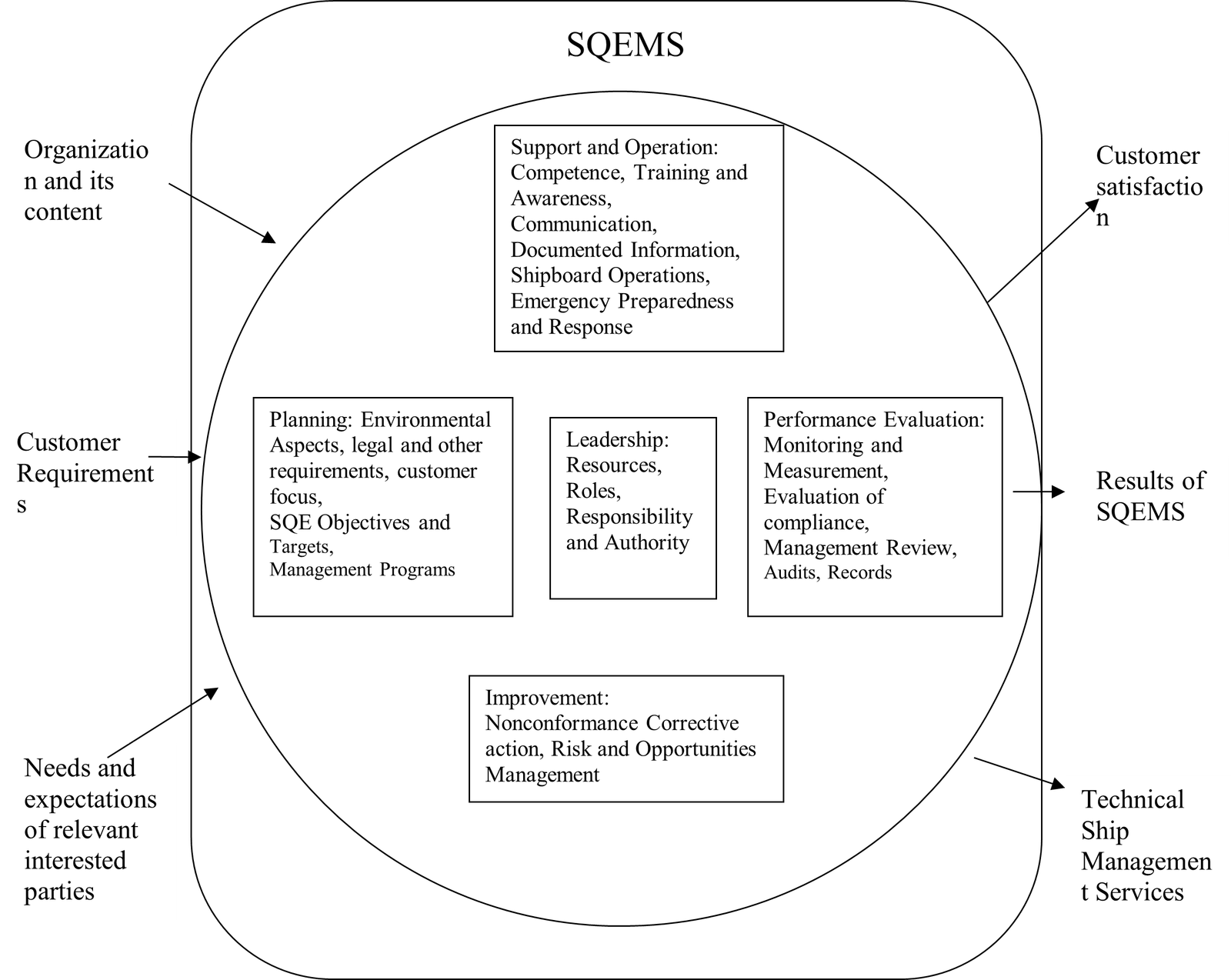
(a) Company has formulated a Safety, Quality and Environmental Management System (hereinafter referred to as “SQEMS”) that seeks conformance to the requirements of ISM Code, international standards ISO9001 & ISO14001, and has also established the safety, quality & environmental management manual (hereinafter referred as “SQEMS Manual”) to implement the services and activities in relation to the system.
(b) For this manual, Company shall hereinafter be referred to as the Company.
(c) All the seafarers working on board managed ship are required to understand this manual and relevant documented information, and to conduct their work in accordance with relevant procedures.
(d) The shore staff working for the company shall ensure that compliance with customer’s requirements and relevant legislations and regulations are always observed while maintaining safety of crew and operations.
(e) The Manual shall outline in general how the various activities or programs shall be:
(i) Established as a formal system or task, and
(ii) Continuously evaluated and improved.
1.3.2. Functional requirements of SQEMS
The SQEMS shall include the following functional requirements:
(a) A safety, health, quality and environmental protection policy;
(b) Instructions and procedures to ensure safe operation of ships and protection of the environment in compliance with relevant international and flag State legislation;
(c) Defined levels of authority and lines of communication between, and amongst, shore and shipboard personnel;
(d) Instructions on procedures for reporting accidents and non-conformities;
(e) Procedures to prepare for and respond to emergency situations;
(f) Procedures for internal audits and management reviews.
1.3.3. Implementation and Improvement of SQEMS
(a) To achieve above requirements effectively and appropriately, the top management of company shall provide necessary resources.
(b) The company shall plan and implement the system to meet the safety, quality and environmental policy established by the MD, and shall improve the effectiveness of the system continually through management reviews held based on the results of corrective or preventive actions, the achievement of the environmental objectives and targets and the quality objectives, the results of the internal audit and the information from the interested parties.
1.3.4. Safety, Quality and Environmental Management System
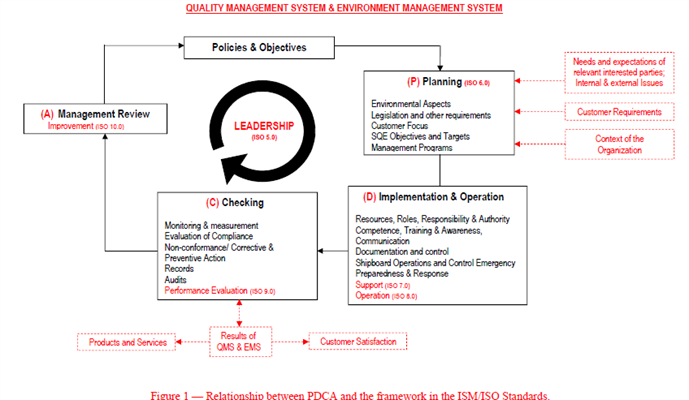
The basis for the approach underlying a Quality and Environmental management system is founded on the concept of Plan-Do-Check-Act (PDCA).
The PDCA model provides an iterative process used by organizations to achieve continual improvement. It can be applied to Quality and Environmental management systems and to each of its individual elements.
It can be briefly described as follows:
P—Plan: Establish environmental objectives and processes necessary to deliver results in accordance with the organization’s environmental policy.
D—Do: Implement the processes as planned.
C—Check: Monitor and measure processes against the environmental policy, including its commitments, environmental objectives and operating criteria, and report the results.
A—Act: Take actions to continually improve.
Figure 1 shows how the framework introduced in the ISM/ISO Standard could be integrated into a PDCA model with its Clauses grouped in relation to the PDCA cycle.
1.3.5. SQEMS Documented Information
The company shall implement, maintain and clarify the following items in the system documented information:
(a) Applications to the process and services in operation of the ships required for the system.
(b) Process flow and interaction between the processes.
(c) Criteria and means for the operation of processes and the effective control of the process.
(d) Availability of the resources and information needed for the support of operation and monitoring of the processes.
(e) Monitoring, measurement and analysis of the processes.
(f) Actions needed for the achievement of the planned results and for achievement of continual improvement.
(g) Where the company chooses to outsource important processes and its management, the company should confirm that the control for the outsourced processes has been implemented properly through the attendance for these services processes and any information related to these processes.
(h) Furthermore, the company shall identify the control of such outsourced processes in the system documented information.
1.3.6. Customer Focus
The company shall obtain information relating to customer satisfaction in the operation of the processes of product realization, guide and supervise the personnel concerned to the system, and provide necessary resources to them so that customer requirements are met with the aim of enhancing customer satisfaction.
1.3.7. Change to the System and Management of Change
When changes to the system are planned and implemented, the Company shall maintain the integrity of the system without affecting or stopping the operation of the system. This shall be ensured by a documented procedure where the potential consequences of a change are identified, together with any risk-reduction measures and communicating the results to those affected by the change.
(ISM Code 2.0 / ISO 9k- 1)
ISM Code-1.3, ISO 9k- 1,4.1,4.3 ISO 14k-1,4.1
ISM Code 1.4 ISO 9k 4.4, 5.1.2, 7.5.1 ISO 14k 4.4, 7.5.1